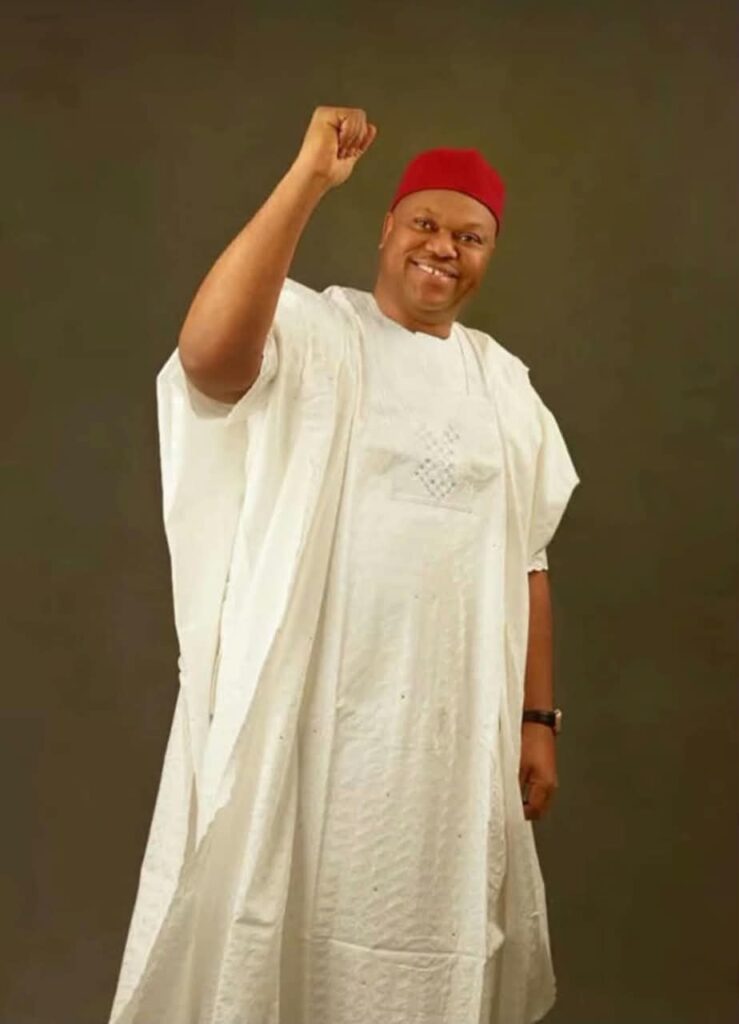
Rt. Hon. Victor Ochei
There is something increasingly difficult to ignore about the politics of Delta North.
The more Rt. Hon. Victor Ochei moves across the nine local government areas of the Senatorial District, the more intense the reaction from the political establishment appears to become.
Now campaign billboards associated with the Nigeria Democratic Congress and its candidates are reportedly being destroyed. The Ochei Campaign Council has called on the security agencies to investigate the incidents and bring whoever is responsible to justice.
That is exactly what should happen.
Nobody should be allowed to destroy another person’s campaign material simply because he disagrees with the political message it carries. In a democracy, the answer to another candidate’s billboard is your own billboard, your own manifesto and your own votes not vandalism.
The law is clear about the right of parties and candidates to conduct lawful campaigns. INEC’s 2026 Regulations expressly recognise campaign activities including posters, handbills and billboards in public places, subject to the applicable laws and regulations. The Electoral Act 2026 also provides a framework for political campaigning and prohibits threats or violence intended to compel people to support or reject a political party or candidate.
Of course, putting up a billboard does not mean that a political party has the right to occupy any location without the required permit or compliance with state and local signage regulations. But where a campaign structure has been lawfully erected, no rival political actor acquires the right to destroy it simply because the message is politically inconvenient.
That is why the alleged destruction of NDC billboards should not be treated as a minor campaign quarrel. If criminal vandalism occurred, the Police and other relevant authorities should identify those responsible and let the law take its course.
But beyond the billboards lies a more interesting political question:
Why does the emergence of Victor Ochei appear to be generating so much anxiety?
The answer may be simpler than the political establishment would like to admit.
For a long time, Delta North politics has operated around familiar names, familiar alliances and familiar assumptions about who can win. Political power has sometimes been treated as though it were inherited property passed from one established bloc to another with the electorate expected merely to ratify the arrangement.
But something is changing.
Ochei has taken his campaign directly to the people. His consultations across the nine local government areas have put him face-to-face with communities, traditional institutions, political stakeholders, professionals, young people, women and ordinary voters.
Whatever anybody thinks of his candidacy, one fact is difficult to dispute: he is making himself visible to the electorate and forcing a conversation about the future of Delta North.
And perhaps that is where the anxiety comes from.
It is easy to dismiss Ochei as a “featherweight” when he is standing still.
It becomes considerably more difficult when the so-called featherweight is moving.
The interesting question therefore is not whether Ochei can be dismissed with political labels. The question is why those who describe him as insignificant appear increasingly eager to respond to him.
If he is truly irrelevant, why the billboards?
Why the attacks?
Why the increasingly aggressive propaganda?
Why the sudden need to remind Delta North repeatedly that the established political order is supposedly unbeatable?
Political strength does not need to destroy its opponent’s billboard. It answers with its own message and waits for election day.
That is the essence of democracy.
The people of Delta North are also not the same electorate they were ten or twenty years ago. Voters are more politically conscious. They have access to information from multiple sources. They compare records. They question political entitlement. They are increasingly willing to ask what has changed in their communities and what kind of representation they want next.
This is why Ochei’s message of a new political direction resonates with a section of the electorate.
He is not entering the race as an unknown political novice. He served three terms in the Delta State House of Assembly and became Speaker of the House. His legislative experience gives him an understanding of government, representation and the workings of the state that cannot simply be dismissed with a campaign slogan.
The real contest, therefore, should not be between “heavyweight” and “featherweight.”
It should be between yesterday and tomorrow.
Between political entitlement and renewed competition.
Between the assumption that power belongs permanently to an established bloc and the democratic principle that the people can choose somebody new.
And this is where I believe Victor Ochei’s candidacy has become significant.
He represents something larger than one Senate seat. He represents the possibility that Delta North can change the political conversation.
The old order may still possess enormous political machinery. It may have money, networks, influence and established structures.
But elections are ultimately decided by voters.
And that is why the billboard issue should concern everybody—not merely the NDC.
If a candidate’s billboard is legally erected, let it stand.
If his message is wrong, challenge it.
If his record is inferior, expose it.
If his opponent is stronger, prove it at the ballot box.
But do not destroy the messenger because you fear the message.
I do not know whether every act of vandalism being reported can properly be attributed to the APC or supporters of Senator Ifeanyi Okowa. That is for the security agencies to investigate and establish. But politically, the incidents should serve as a warning against allowing competition to degenerate into intimidation.
Delta North does not need political violence.
It does not need fear.
It does not need the politics of silence.
It needs a contest in which every candidate is free to speak, every party is free to campaign lawfully, and every voter is free to make an independent choice.
And come January 16, 2027, the loudest billboard will not be the one standing by the roadside.
It will be the ballot box.That is where Delta North will finally answer the question that political propaganda cannot settle:
Is the old order still enough or is the time right for a new political sheriff?
For me, the growing presence of Victor Ochei suggests that the question is no longer theoretical.
*The contest has begun. And Delta North is watching.