THE SUPREME COURT JUDGMENT: ANAUGHE’S ARGUMENT DOES NOT ANSWER THE REAL QUESTION..
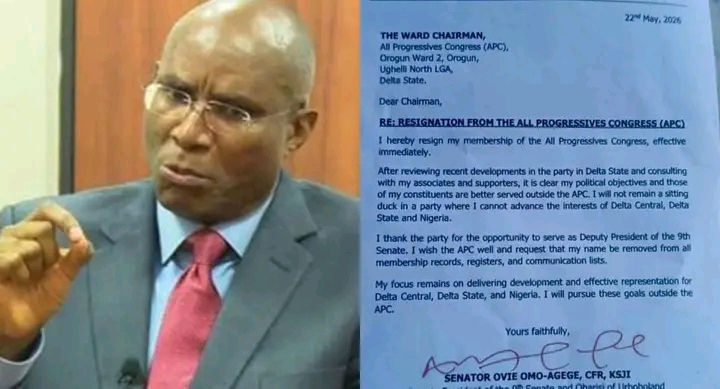
The statement issued by Godwin Anaughe on behalf of Senator Ovie Omo-Agege is more political rhetoric than a response to the legal issue now before the public.
Nobody needs the Supreme Court to have written “Omo-Agege is disqualified” for the judgment to have consequences for the circumstances surrounding his candidacy.
The Supreme Court has just restored Sections 77(5), 77(6), 77(7) and 84(2) of the Electoral Act 2026. Those provisions deal directly with party membership registers and participation in party primaries.
That is where the real question begins.
Omo-Agege contested the APC Delta Central Senatorial primary on May 18, 2026. The APC officially declared Senator Ede Dafinone the winner, with 116,252 votes against Omo-Agege’s 3,643.
Days later, Omo-Agege left the APC, joined the NDC and received an NDC waiver to pursue the Delta Central Senate ticket.
He then participated in the NDC Delta Central senatorial primary. Reports at the time documented competing claims over that primary’s outcome.
Therefore, the issue cannot simply be dismissed by saying:
“The Supreme Court did not make an order against Omo-Agege.”
Of course, it did not determine Omo-Agege’s individual candidacy in that judgment. The case before the Court concerned the constitutionality of the Electoral Act provisions.
But those provisions have now been restored.
The relevant question is therefore not whether the Supreme Court mentioned Omo-Agege by name. The relevant question is whether his participation in the NDC nomination process complied with the very statutory membership-register requirements that the Supreme Court has now restored.
Where was his name in the NDC register submitted to INEC?
When was he admitted into the NDC?
When was his name entered into the register?
Was the register subsequently updated in a manner permitted by the Electoral Act?
And, most importantly, was he legally entitled to participate in the NDC primary under Section 77(5) after having already participated in another party’s primary for the same senatorial seat?
Those are factual and legal questions that a press statement cannot answer.
Anaughe’s statement says Omo-Agege is “duly registered” and that his name appears on the NDC register submitted to INEC. That is a claim that should be supported by the actual INEC-acknowledged register and the relevant dates, not merely repeated in a press release.
The argument also conveniently skips over the chronology:
APC PRIMARY → DEFEAT/DISPUTE → EXIT FROM APC → JOIN NDC → NDC WAIVER → NDC PRIMARY.
That chronology is not erased because the Supreme Court did not name Omo-Agege personally.
Equally, supporters of Ede Dafinone did not claim that the Supreme Court has already declared Omo-Agege disqualified. What the judgment does is restore the statutory framework under which the legality of party membership registers and participation in primaries must be examined.
So the proper response to Anaughe is simple:
Don’t declare Ovie Omo-Agege “unaffected” when the restored law directly raises questions about the legality of the process through which he moved from one party’s primary to another party’s primary.
Let the register, the dates, the primary records and the law speak.
That is the issue Anaughe’s statement has not answered.