Food adulteration poses a serious threat to public health, child nutrition and business confidence in Nigeria, prompting calls for stronger regulatory enforcement, improved food traceability and greater accountability across the food supply chain.
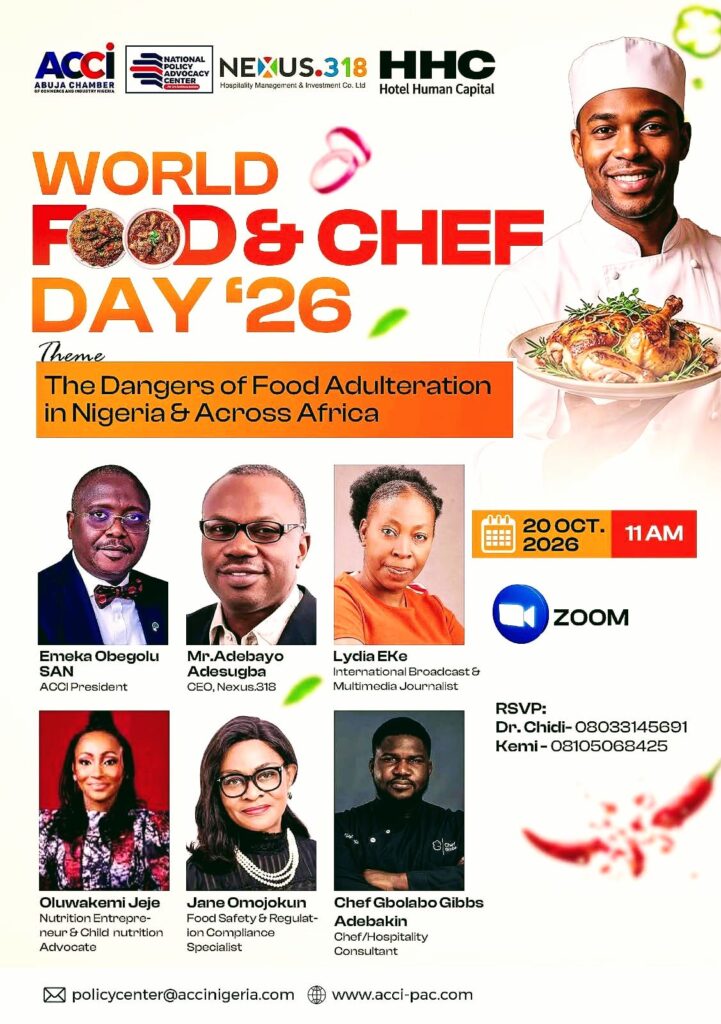
The warning featured prominently at a webinar marking World Food Day and International Chefs Day 2026, held on October 20, under the theme, “The Dangers of Food Adulteration in Nigeria and Across Africa.” The event was convened by Nexus318 Hospitality, in partnership with the Abuja Chamber of Commerce and Industry (ACCI) and Hotel Human Capital (HHC).
In remarks delivered on behalf of ACCI President, Chief Emeka Obegolu, SAN, Dr Tinuke stressed the importance of protecting food integrity, describing adulteration as more than a violation of consumer rights.
In his prepared address, Obegolu stated that food adulteration was “not merely a violation of consumer rights; it is a serious public health concern.” He added that “safe food is both a public health necessity and an economic asset,” urging stakeholders to move beyond awareness to practical action.
The Lead Convener and Founder of Nexus318 Hospitality, Mr Adedayo Adesugba, described food adulteration as a “national emergency”, highlighting the need for urgent, coordinated action to protect consumers.
In a presentation titled “Understanding Food Adulteration: Forms, Methods and Drivers,” Lydia Enyidiya Eke examined the different forms of adulteration, the methods used and the factors driving the practice. She raised concerns about suspected adulteration involving palm oil, honey, tomato paste, milk and chocolate beverages, as well as the potential use of unsafe substances in food processing.
Eke concluded by challenging stakeholders with three questions: “Who is protecting the Nigerian and African consumer? Who holds dishonest food producers and traders accountable? How do we ensure that the food we eat is authentic, safe and honestly produced?”
Jane Omojokun, managing director and lead consultant at Nugata Consults Limited, presented “Preventing Food Adulteration: Food Safety Systems, Verification and Compliance.” She warned that food could appear normal without being safe or authentic, advocating supplier verification, traceability and effective food safety management.
Omojokun stressed that food integrity was everyone’s responsibility, calling on producers to use safe inputs, processors to verify raw materials and traders to preserve product quality and traceability. She urged chefs and hospitality operators to source responsibly, retailers to reject suspicious stock, regulators to enforce standards fairly and consumers to report credible concerns.
She identified education, collaboration and accountability as priorities, recommending public awareness campaigns in local languages, intelligence-sharing among regulators, laboratories, businesses and communities, and systems for tracking complaints, corrective actions and repeat violations.
Oluwakemi Jeje, a farmer, processor and founder of Community Pot Initiative and WholeEats Africa, examined adulteration across three critical stages: the farm, where nutrients are grown; processing, where nutrients are preserved or lost; and feeding programmes, where children bear the consequences.
She highlighted how unsafe agricultural inputs, poor handling and storage, questionable processing practices and misleading nutritional claims can compromise food quality and undermine child nutrition. Jeje stressed that safe food is not a luxury but the foundation of good nutrition and a fundamental requirement for public health.
“Every child deserves more than a full stomach,” she emphasised, arguing that children need food that is safe, nutritious and honestly produced.
The webinar was moderated by Engr. Chibuikem Diala, who guided discussions on food integrity, consumer protection and stakeholder accountability.
The presentations called for stronger regulatory monitoring, laboratory testing, responsible sourcing, accurate labelling and effective enforcement. Speakers stressed that coordinated action across the food supply chain was essential to protecting consumers and restoring confidence in Nigeria’s food system.
Signed
Nexus318 Hospitality
24/10/26