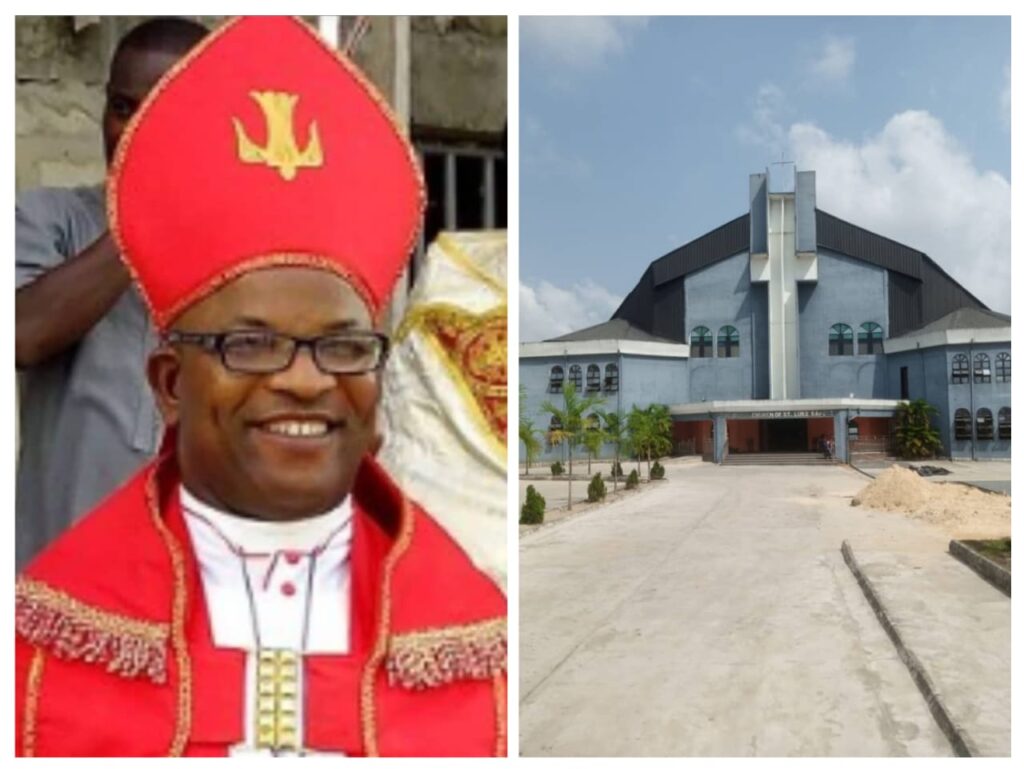
A deeply concerned and neutral member of the Anglican Church if Nigeria, Sapele Diocese, Brother Amos Amiele Akhigbehas offered what he strongly believes will translate into a last solution to address and satisfactorily resolve the lingering crisis that has negatively impacted on the spiritual and administrative affairs of the famous St. Luke’s Cathedral in the Diocese.
Brother Amiele, who had prayerfully reflected on the Primate’s Directives as conveyed in his referenced letter on the matter, says he feels constrained in conscience to humbly offer his observations and suggestions for the consideration of the leadership of the Church of Nigeria, which he has published in the statement below.
The full statement reads:
CONCERNED MEMBER OF THE ANGLICAN CHURCH IN NIGERIA
A RESPONSE FROM A CONCERNED MEMBER OF THE CHURCH
Beloved in Christ,
Grace, mercy and peace be multiplied to you in the name of our Lord Jesus Christ.
I write as a neutral and deeply concerned member of the Church who earnestly desires a lasting and God-honouring resolution to the protracted crisis in the Diocese of Sapele, particularly as it concerns St. Luke’s Cathedral.
Having prayerfully reflected on the Primate’s Directives as conveyed in the referenced letter, I feel constrained in conscience to humbly offer the following observations for the consideration of the leadership of the Church of Nigeria.
First, it is important to acknowledge the genuine concern of the Primate and the House of Bishops to bring an end to a crisis that has lingered for about nine years. This concern is appreciated. However, it must be respectfully stated that the tone and approach adopted in the directives appear largely military and authoritarian in character.
Experience has shown that such an approach, especially in a crisis of this depth, history and emotional investment, may not only fail to heal the wounds but could further harden positions and prolong the conflict.
It is also increasingly obvious that the Church of Nigeria Alternative Dispute Resolution Taskforce (CoNADRT) may not have undertaken a sufficiently comprehensive, detailed and inclusive investigation of the crisis. As a result, the Committee appears not to have been fully abreast of the realities on ground, the deep-rooted grievances, and the complex historical dynamics that have sustained the conflict over the years.
This gap, regrettably, seems to have led to advice that does not adequately address the underlying issues, and which may have inadvertently informed the present authoritative posture adopted by the Primate by insisting that Erifeta would be enabled and assisted to take over the Cathedral of St Luke on the 18 January 2026.
It is worth recalling that even a former Primate of the Church of Nigeria, himself a retired military officer, appreciated the gravity and intensity of the animosity surrounding this crisis and therefore chose to apply a more civil, patient and consultative approach. That wisdom appeared to recognize that ecclesiastical conflicts of this nature require persuasion, dialogue and healing, rather than directives alone.
In crises of this magnitude, it is a well-established principle that stakeholders with institutional memory and deep knowledge of the genesis of the conflict should be deliberately consulted. Sadly, this does not appear to have been the case.
Key and highly relevant persons such as Archbishop Chukwuma, Friday Imakhai (rtd), Bishop Ide, the former Chancellor who resigned, among others, were not engaged. Equally concerning is the apparent failure to consult prominent members of the Rescue Group, both individually and collectively, whose perspectives are critical to any enduring solution.
Furthermore, the few meetings reportedly held under the auspices of the ADR process were hosted by Bishop Erifeta and were characterized, according to widespread accounts, by browbeating and instructions rather than genuine listening and mediation. This unfortunately mirrors the very posture now evident in the Primate’s directives and does little to inspire confidence in the reconciliatory process.
It is also important to note that reconciliation, by its very nature, is a process and not an event. Before any service of reconciliation can be meaningful and effective, aggrieved parties and critical stakeholders ought to have been met—first separately, and thereafter jointly—to ventilate grievances, build trust and reach mutual understanding.
This condition precedent appears to have been overlooked. History and experience warn us that when such foundational steps are neglected, the consequences can be deeply unpalatable and counterproductive.
In light of the foregoing, I humbly advise the Church of Nigeria to prayerfully reconsider its present approach and to adopt a more diplomatic, inclusive and wisdom-driven pathway. The crisis in Sapele Diocese requires not only authority, but discernment; not only directives, but dialogue; and not only speed, but depth.
My earnest prayer is that the Lord will grant the Primate, the House of Bishops, and all involved the wisdom from above-pure, peaceable, gentle and full of mercy-to guide this process to a truly lasting and God-glorifying resolution.
Yours faithfully in Christ,
Amos Amiele Akhigbe
A Concerned Member of the Church