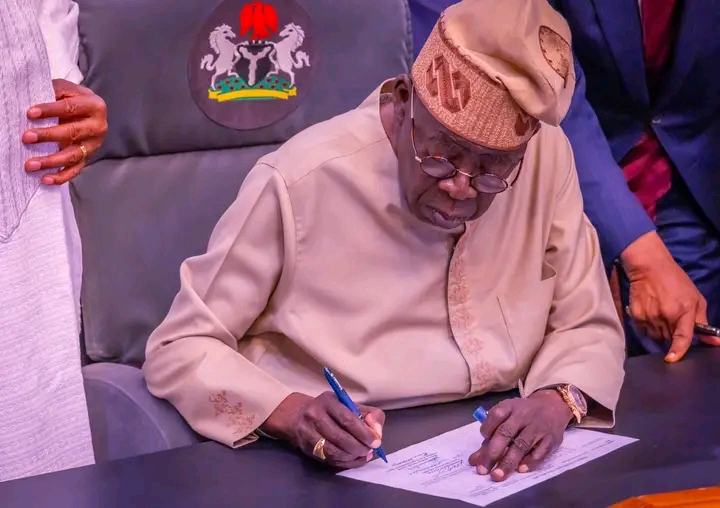
President Bola Ahmed Tinubu has signed the Electoral Act 2026 (Amendment) Bill into law on 18 February 2026. This bill replaces the previous Electoral Act of 2022 and updates Nigeria’s election laws ahead of the 2027 general elections.
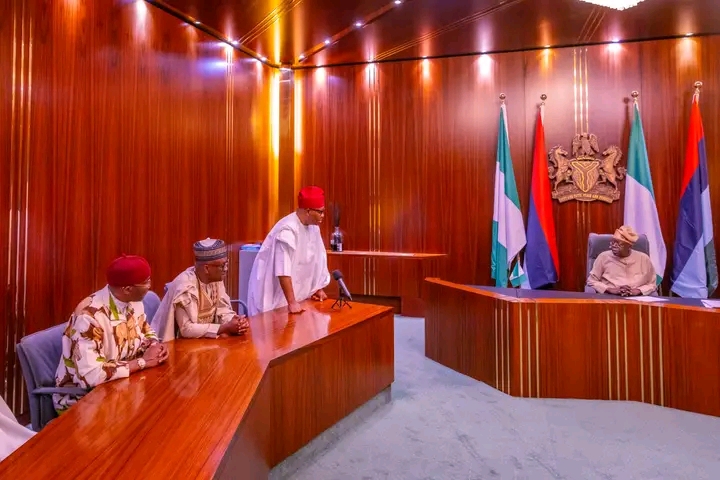
The signing took place at the Presidential Villa in Abuja in a brief ceremony attended by the principal officers of the National Assembly. The updated Electoral Act 2026 lays out the legal framework for how the 2027 general elections will be conducted, including the presidential election scheduled for 20 February 2027 and governorship/state assembly polls on 6 March 2027.
Lawmakers debated the bill extensively, especially around how election results are transmitted, balancing between electronic systems and manual backups.
The Key Changes: While the full official text isn’t published yet, reports say the amended law includes changes to:Notice period for elections (reduced from 360 to 300 days),Procedures for transmitting election results electronically, Administrative and timeline updates for INEC’s operations under the new framework.
Speaking at this signing ceremony, President Tinubu noted that Electoral Act amendments are not about politics, they are about process, adding that after every election cycle, we owe Nigerians an honest look at what worked and what must work better. That is how serious democracies behave, and our laws must grow with experience.

He said:”Today, I signed the final amendments to the 2022 Electoral Act into law.
These amendments are not about politics. They are about process. They are about closing gaps, strengthening procedures, and providing greater clarity to those who conduct and participate in our elections.
When citizens walk into a polling unit, they must do so with confidence. When results are declared, they must be trusted. That confidence is built deliberately, and not by chance.
I sincerely thank the National Assembly for its cooperation and sense of national responsibility in bringing this process to a successful conclusion. Our responsibility remains to keep improving the system so that the people’s will is expressed clearly, peacefully, and credibly.
The work of strengthening our democracy continues, and we shall not relent.”
SENATOR NATASHA AKPOTI-UDUAGHAN REACTS

Senator Natasha Akpoti-Uduaghan of Kogi Central Senatorial zone has reacted swiftly to the signing of the Electoral Amendment Act into Law by President Buhati
According to online reports credited to her, she allegedly posted that: “As President Tinubu signs the Electoral Act Amendment Bill 2026 into Law, citizens should note the following 7 major changes:
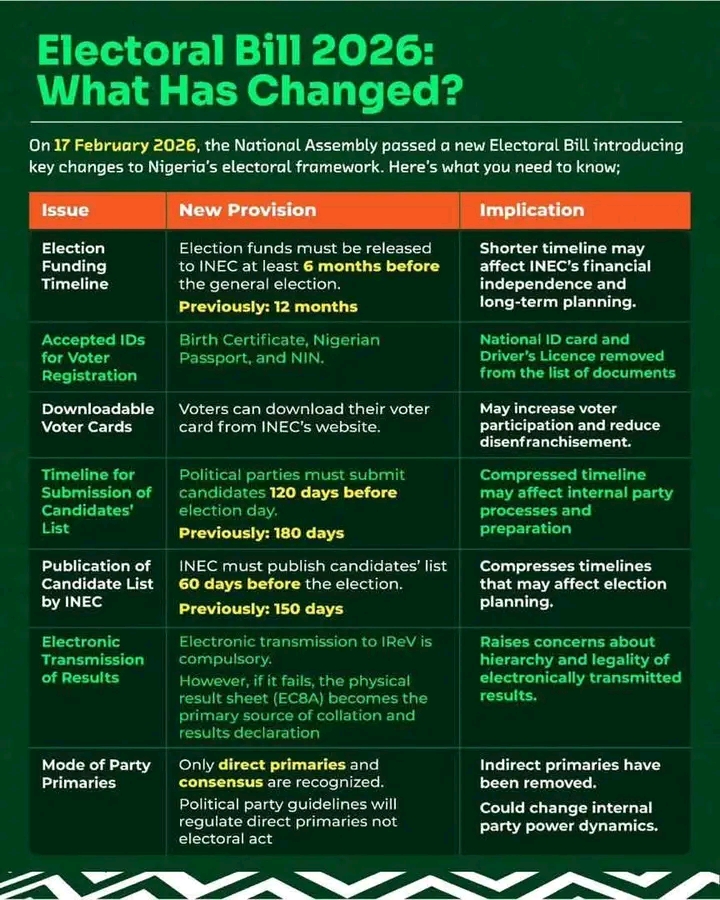
- Voter registration: Documents required for voter registration are narrowed to 3 : a birth certificate, a Nigerian passport and a National Identification Number (NIN).
- Downloadable voter card: Voters can download their voter card from INEC’s website.
- Electronic transmission of results: Electronic transmission to IReV is compulsory.
However, if it fails, the physical result sheet (EC8A) becomes the primary source of collation and results declaration. - Mode of party primary election: The new bill adopts direct primaries and consensus as the only methods for political parties to nominate candidates.
- Disbursement of funds to INEC: Election funds must be released to INEC at least 6 months before the general election. Previously: 12 months.
- Deadline for submission of candidates’ list: Political parties must submit candidates 120 days before election day. Previously: 180 days
- INEC’s final list of candidates; INEC must publish candidates’ list 60 days before the election. Previously: 150 days.
Except for the provisor in Section 60 (3) which holds that upon network failure inhibiting electronic transmission; form EC8A becomes the primary mode of collation and result transmission . I’ll say the other amendments are fine.
At this juncture, the National Assembly has done its part. The Presidency too.
Now its left for every citizens to channel their attention to INEC and ensure it:
• Strictly complies with the law and equally treats all political parties and candidates.
• Deploys technology effectively for voter accreditation, result transmission, and real-time transparency.
• Guarantees timely logistics and efficient distribution of election materials.
• Protects the integrity of the voters’ register and prevents manipulation.
• Works closely with security agencies to ensure peaceful, violence-free polls.
• Promptly uploads and publish results to strengthen public trust.
Ultimately, Nigerians are the true government and every institution actually is accountable to the people.
The people MUST follow the money and question every kobo of the ₦873 billion to be released for the 2027 elections.
Question the quality of BVAS machines.
Insist on smarter softwares for BVAS and IREV systems.
Demand a partnership with a network provider e.g. Starlink for a sure nationwide service for the election week. Coverage over the 177,000 polling unit should cost more than ₦65billion.
Lastly, laws are dynamic not absolute. They are made by men to serve mankind and can ve challenged in the courts of law. Therefore Citizens who are dissatisfied with any or all of the amendments can challenge the Electoral Act 2026 via a judicial action.
Senator Natasha H Akpoti Uduaghan
Viva Kogi Central
Viva Nigeria